FRANK TALK ABOUT WHAT WE DO WITH OUR LIVES

Archive for the ‘Essays’ Category

Rich Beyond Measure

In Essays on September 7, 2011 at 8:35 am

By Pamela Arturi

I will never forget the first time I stepped foot at Southbury Training School, Connecticut’s last remaining warehouse for the disabled and mentally ill. I was 22, completely green, and determined to change the world for people with disabilities. I had ascended the hill of the sprawling campus in my Honda Accord hatchback emblazoned with bumper stickers, including one that read: “Subvert the Dominant Paradigm.”

I remember so clearly that it was a beautiful, sunny day outside. I noticed the large brick buildings built in the 1940s, now in great disrepair and covered in ivy growing wild. There were dilapidated swing sets and play sets around the buildings left from the days when children lived there. These buildings, or “cottages” as they were called, housed upwards of 35 people at a time.

During my first tour of the grounds, I was taken around by my advocate partner who would work with me on the assigned cases. I recall standing in one of the buildings for the most physically and cognitively disabled residents, thinking I could not believe my eyes. In the dormitory where the clients slept, I saw cold tile floors, plain grey cinderblock walls with no personal effects, beds lined up head to toe around the room, at most a few inches away from each other. The bathroom was a large room with toilets and no stalls. In another large room, there were showers and a couple of tubs, again no stalls or curtains.

I was then taken into the “day room.” On the floor around me were people lying on mats, some moaning, their arms and legs contracted from years without therapy or exercise. One attendant milled around. The stench of urine and feces was overwhelming. I was reminded of a Mahatma Ghandi quote: “A nation’s greatness is measured by how it treats its weakest members.” By this standard, we as a culture were failing miserably.

I vividly recall looking out the window at the bright, sunny day and then looking in towards the room and having a career-defining moment. It was practically an out-of-body experience. I looked up and said to myself silently, “If there is anything that I do with my life, it will be to make this go away.”  This statement is the standard by which I rate my work every day. Before I go to sleep at night, I ask myself, “Did I do something today to make that go away?”

Working at the institution as an advocate was an eye-opening experience and invaluable education. I saw some things that will be forever burned onto my brain. Terrible things that one could never imagine. As an advocate, I was assigned overflow cases from the state investigators. I also worked with residents moving out into the community so that they could live their lives outside the four walls of an institution.

In 1994, in preparation for a class action lawsuit being brought against the state to close the institution, my partner and I were responsible for reviewing old files, gathering information, interviews, and facts to be used in the class action. It was all very “Thelma and Louise” meets “Erin Brokovich.” It was an emotionally-charged time, as word got out that a lawsuit was being brought to move people out and, in effect, to close the institution. During that time, on occasion I received threats and anonymous phone calls. I routinely checked my car tires before leaving for the day. I testified in hearings where I was booed and hissed at. In 1996, the class action suit was brought against the State of Connecticut to close Southbury Training School. A few months ago, in an act of narcissism, I googled myself and my testimony from one of the hearings came up in the search. After I opened it with a bit of trepidation, I was pleasantly surprised to read that what I wrote 18 years ago is exactly what I would say today.

Some years and several positions later, I went to work for an agency that is now called Ability Beyond Disability, an organization that serves over 1,500 individuals in Connecticut and New York and provides many different services so that people can remain as independent as possible while receiving the support they need. Some people use Ability Beyond Disability services for as few as two hours a week and other people use our services 24 hours a day.

I will never forget seeing one of my advocate friends at a meeting shortly after I was hired. Upon learning that I was now working for a service provider, supervising residential services for people with disabilities in the community, she admonished me for taking the leap into service provision from advocacy. She told me that I had “turned to the dark side,” that I had abandoned my vision for advocating change for persons with disabilities. I staunchly defended my decision, stating that I believed in the core values and mission of the agency and that I remained true to my vision as an advocate in the work that I do every day. I listened to her criticism, but I knew in my heart I had made the right decision in my career.

Fast forward 11 years and two promotions. I remain with Ability Beyond Disability and oversee programs and services in Connecticut on an administrative level. My friends with high-powered careers and huge salaries joke with me and say things like, “Pam, it’s great to be Mother Teresa, but it won’t make you rich.” I strongly disagree. I will give you an example of the riches I experience in my daily work life.

A few months ago, I was asked to go meet a young woman, Rose*, who had been placed in a terrible nursing home in Wethersfield, Connecticut. Rose had lost her group home placement due to a severe medical condition and had been at the nursing home for two years. She was blind as a result of her medical condition and limited verbally. When I saw her, it was apparent that she was heavily sedated. She was wearing “onesie” outfits because the staff reported that she “stripped” her clothing and bed linens. She was lying on a bare mattress with nothing to do and no interaction with others. She was very thin, even though staff reported that they fed her because she took too long to eat by herself. She never left the nursing home.

As I left the facility with my team, I said, “We’re going to get her out of here.” Rose was placed on my agency’s waiting list and when an opening came up in one of our lovely six-bed homes, it was hers. Last week, while conducting a tour in one of our group homes, I met Rose again, for the first time since she had been in our care. She no longer needed the “onesies,” as it turned out the staff at the nursing home would not walk her to the toilet, so her “stripping” was to remove her soiled clothing and bed linens. Her medications had been adjusted; she was now sleeping more at night and was increasingly alert during the day. She had gained weight, her hair had grown, and she looked beautiful. She goes into the community with her support staff to get coffee, a favorite meal, purchase new music, or do some shopping. Her quality of life has changed drastically for the better. As I visited with her and her support staff in her bedroom, purposely painted bright yellow for her vision and beautifully decorated with pictures of flowers, I was almost brought to tears, seeing her alert, dressed in a sharply-coordinated outfit, and singing to her music. No amount of money can compare to an experience like that. I am rich beyond measure.

Finally this past year, the STS lawsuit was settled. There is now a mandate to educate families and clients about transitioning to community-based services, and the plan is for STS to be closed within five years. I was asked by my agency to participate on our outreach team to the institution. As I sat around the table a few weeks ago talking about strategic planning for the outreach project, all my memories of working as an advocate at STS came flooding back. I remembered my advocate friend criticizing me for my decision to move into service provision. I felt an overwhelming sense of my career coming full circle and my career decisions being validated.

That night before I went to bed, I asked myself my daily question: “Today, did I do something to make that go away?” Absolutely.

*Name has been changed.

Photo provided by Pamela Arturi.


My Secret Identity

In Essays on August 31, 2011 at 8:24 am

By Terri Rowe

Secret identities aren’t just for super heroes. You might not know it to look at me, but I have one, too. In my everyday life, I am an ordinary blue-collar worker. I have held a wide variety of jobs since my youth, from food service to factory. But there is more to me than what you see.

For the past 17 years, I worked at a tier-one auto parts supply plant. I assembled the components of automotive interiors: headliners, floor consoles, overhead consoles. These days, I continue to work in manufacturing. However, my role will soon be changing as I train to become a technical operator focused on the building of hybrid batteries. The work I do on a daily basis consumes my energy and time, but it isn’t who I really am.

The work has been steady, but never easy. It has been hard to be part of the working class that people deride. I worked for a shop that was non-union, and people would still complain that the employees sweating it out on the production floor were bleeding the company’s resources dry.

My fellow workers and I have endured a lot in this ever-changing global economy. There have been multiple pay cuts. The stress that comes with those can be harrowing. Even before our last pay cut, when I was considering buying my own home for the first time in my life, I qualified for a low-income loan. And yet, some survey indicated to the CEO of our company that my coworkers and I were overpaid for employees in our region, so a thirty percent pay cut was in order.

I stayed with my job even as its ability to support me dwindled. There were no other companies hiring in my region. I was one of the lucky ones; I managed to keep my home. For the first time in my life, I was grateful I didn’t have children as I watched my friends struggle to support their families. It was so discouraging to see so many people whose homes were foreclosed having to move in with either their elderly parents or their adult children.

Please understand: I’ve always been grateful to have a job to go to each day. I am proud of the high-quality parts that I make with my hands and by the sweat of my brow. I am proud that I push my body to its limits and follow long-held traditions in my family.

When I was in my early twenties, I worked as a temporary worker in a furniture manufacturing company. I helped assemble small- to medium-sized filing cabinets. One of the jobs I was trained for was a final inspection. When I told my dad, he said that was something his father used to do in the 1950s when he worked at a refrigerator manufacturer. He was known as the ding man because he could repair any dent or nick at the final inspection post. Since my grandfather had passed away years before I was born, I felt a strong connection to him through my work and a great pride.

The next permanent job I got was the one for the automotive supply company. I was proud to start working there; again I felt a family connection, this time to my mother’s father who spent many years working on the assembly line for a taxi cab company.

But the work was hard. There were efficiency goals that had to be met, no excuses. It was hot, well above 120 degrees Fahrenheit over by the forming press. I was highly allergic to some of the chemicals. This caused my skin to peel off in sheets; I would wake up with blood smeared across my pillow. My friend Brandi would say, quite often, I know this isn’t what my mama had in mind when she used to dress me up in lace ankle socks, patent leather shoes, and a frilly dress. I had to agree. Would any mom wish this for their child? Would Kenny’s mom have envisioned this future for her son when she dressed him in short pants, knee socks, and a clip-on tie each Sunday? Family traditions aside, this is no parent’s dream for their child.

I persevered with that job, eventually getting transferred to another plant. I know some people will argue as long as they have breath that production workers of most stripes are overpaid. And I know that in some cases this is true. But what I have witnessed every day is people working extremely hard to reach ambitious goals, people who sacrifice the strength and health of their bodies to complete their work to exacting standards. The processes are difficult. Even when you take great care, there is the possibility of injury, especially due to repetitive motion. By the time most of my friends will be able to retire, they will not have a very high level of physical health left with which to enjoy their “golden years.” Most of them will never actually be able to fully retire. This is a truth I accepted for myself long ago.

I know what brought me down the path I’ve traveled. In my youth, I suffered from an incredible lack of foresight. I tried going to college. I took out loans and cheerily went off to my freshman year. Yet, when I saw the amount of money I needed to borrow at the start of each semester, it made me physically ill. I had no idea how I’d ever pay off such a high debt load.

I took on a job working third shift. My attention to my school work diminished with each hour I worked, and I eventually quit college all together. A friend’s mother asked me, “Doesn’t it feel better to earn money than to spend it?” I had to agree with her…it did.

And yet, even as I toiled away in the various jobs I worked, accepting my identity as a factory rat, I still kept a dream from my childhood alive. I had a secret purpose, a secret identity.

When I was four years old, I was still an only child. I loved a television show about a large family growing up in Virginia during the 1930s. I really identified with the oldest child in the family because he wanted to be a writer. I knew, even at that young age, that I wanted that, too. I also really wanted six younger brothers and sisters. When we went places, like to the park, and people would ask me what my name was, I would happily tell them it was John-Boy. They would look quizzically at my mother. She would just shrug. She wasn’t one to stifle her children in any way, even if her little girl told everyone she met that her name was John-Boy Walton.

Over the years, I have continued to write. My work has always been busy and intense for my physical being, but I’ve had plenty of time to allow my mind to wander, exploring story lines, working out plot points, developing characters. At the end of my shift, I would hurry home to capture my ideas on paper.

I managed to get one short story published once. I entered a contest in our local paper. Sometimes I think that maybe the only reason I won was because I was the only one who entered, but really, it was the encouragement I needed to keep dreaming.

I found my way back to college, eventually. I went to school strictly to study all the subjects that interested me and would feed my soul as a writer. My degree may not ever translate into a high-paying job, but it gave me exactly what I needed. As I studied the human narrative through literature and psychology, I learned to understand myself more and how my story fits in with everyone else’s story. I managed to have great success with my studies as an adult, 20 years after my first attempt.

I found a new path as a writer when a friend encouraged me to write a story as a present for a Christmas gift exchange. I ended up writing a children’s story for my coworker’s daughter. It was very much appreciated.

Since then, I’ve continued to write stories as a way to share thoughts and ideas with my friends and their children. My writing dreams and goals may be small and personal. I may never be widely read. I may never make a best sellers list. But I am a writer nonetheless. This is who I really am.

Photo provided by Terri Rowe.

Pushing My Post

In Essays on August 24, 2011 at 7:44 am

By Michael T. Heath

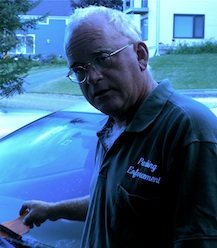
It was a warm day, causing me to shirk half my territory and stick to the shady side of every street. No matter: there were 1400 parking meters in town, and I was assigned a ton of them. The keyboard of my Alyn 255 hand-held thrummed as I clipped a $12 fine under the windshield wiper of yet another Acura. Cars run in waves in the parking enforcement business: today it was Acuras; yesterday it had been Toyotas. I sighed and ambled down the block, trying to do my job and still hold back from getting all gung-ho about it like most of my co-workers. Some of them acted like wanna-be cops, writing scads of tickets and towing every vehicle they could. (I abhor this attitude, the pain I inflict, and the job itself, but circumstances dictate I’ll keep tapping that damn keyboard well into the foreseeable future.)

My radio crackled to life: “All units. A reminder to be back to the station by noon—sharp. The Chief will be addressing everyone in the conference room.” Our police chief was vaguely militaristic and a stickler for detail. It would not be wise to challenge him today, of all days. I checked the time: 11:38. Better head back; maybe there’d be a few goodies the cops hadn’t yet scarfed up.

The large space was packed to the gills, and the few doughnuts were long gone when I arrived. I snagged a bottle of water and a chair near other members of the parking enforcement crew. Nods all around but little talk—most were thrilled to be among the boys in blue on a big day. A trim man in a spotless uniform strode to the podium and the chatter died quickly. “Good afternoon. We are fortunate to have with us today several officers from the Shelburne, Williston and Colchester police forces to assist with the First Lady’s visit. Additionally, our parking enforcement department is pitching in to fill a few gaps on her route. Deputy Chief Decker will instruct non-BPD people where you’ll be posted.” I’d heard that in Secret Service parlance ‘pushing a post’ was the term used for a station along a presidential detail’s route. It looked as if I’d get the chance to participate (however feebly) in protecting Mrs. Obama just this once in my life.

Assignments given, we caught rides to our appointed stands. Mine was a little-used side road off Main Street which already had traffic cones dotted across it. I waved to my ride and then tuned my hand-held radio to channel 2. This was used exclusively by BPD, and soon clotted up with brief check-in messages from the two-mile stretch of road her VIP convoy would take. When my number was called I responded affirmatively. Turning to look down Summit Street, I saw three vehicles approaching my position. The lead car (an Acura, of course) stopped and a well-dressed woman leaned out her window to ask what was going on. I told her the road would be closed for the next five minutes and she smiled. “Mrs. Obama is coming through, isn’t she?” I nodded and she put her car in park, fiddling with the radio. Before I could speak to them the other drivers had executed swift U-turns and were headed back to see if they could get around the obstruction (unlikely, I thought). I paced comfortably around the mouth of the road, adjusting the orange cones slightly to better cover the area. Another car drove up at a fast pace with windows open and raucous music disturbing the calm air. The driver impatiently revved his engine and tapped his horn, waving me toward his driver’s window. I returned the gesture, unwilling to leave my place in front of the first car. He flipped me off, squealing tires as he rapidly backed into the closest driveway, turned and blared off back the way he’d come. Works for me.

The woman in the front car smiled and we both shrugged our shoulders as if to say, “What are you going to do?” She had adjusted her mindset to waiting patiently, philosophical about the delay. My portable radio crackled once again, warning us the convoy had begun to move out. I turned and watched as four police motorcycles and then a line of SUVs and limousines scooted past and vanished down the street. A few moments later, I was given the “All Clear” signal and I picked up the barrier of cones, waving my lone charge through. She stopped alongside me briefly, unperturbed by the short interruption of her journey. “I didn’t mind waiting for her,” she said softly. “She makes a difference no matter what she does each day.” Her car eased past me and rolled away on Main Street. Perhaps just this once—in a job I detested—I had, too.

Photo provided by Michael T. Heath.

Pilgrim to Professional: One Minister’s Story

In Essays on August 19, 2011 at 2:08 pm

By Kelly Murphy Mason

A few things that seem self-evident about me—that I was raised Roman Catholic; that I left the Holy Catholic and Apostolic Church as a young adult; and that I remain as culturally Catholic today as I was when I wore a plaid jumper to St. Catherine’s parochial school—are not equally obvious to everyone else. I learned this most vividly when I was an upper-class seminarian at an interdenominational divinity school, during a conversation with two Episcopalians in the library, one of whom was known to me and another who was unknown. I said something off-handed about my “clearly” being a former Catholic and was startled by the unknown Episcopalian’s response. “Why clearly?” he asked.

“Because obviously, I’m no longer a practicing Catholic,” I said. “I mean I’m here—I’ve been preparing for ordination for a while now.”

“And…?” the unknown Episcopalian replied.

“And?” I asked with baited breath, expecting a punchline. None came. He was entirely sincere, and there did not seem to be a hidden camera nearby. “And the Catholics don’t ordain women,” I told him, finally.

“They don’t?” he said, taken aback.

“No, they don’t.”

“Really?”

“Really,” I said, dumbstruck. “What did you think?”

“Honestly, I thought the Catholics were pretty much like Episcopalians,” he admitted, “only with a pope.”

“Not so,” I said. “They really are very different from one another.” At this point, the other Episcopalian, the one I knew, was shaking his head vigorously, as plainly flummoxed by this conversation as I was.

“So the Catholics do not ordain women,” the unknown Episcopalian declared.

“No!” I said.

“Well, that disappoints me,” he said, rather understated in his response, using the most civil of tones. “Truthfully,” he added, “it makes me think a little less of them.”

Of course, we can all find excuses to think a little less of one another’s faith traditions, but if we start to think little enough of our own, eventually, we’re likely to abandon it for something else altogether—as well we might. It took me years to realize that if I felt driven out of the Holy Catholic and Apostolic Church, there might still be other places I could go, including a place where people would receive me happily, with something akin to joy.

In my twenties, I found that place on Sixteenth Street in Washington, D.C., the spiritual spine of our nation’s capital, a stretch of road lined for miles with churches, synagogues, mosques, temples, and basilicas. It was there I started attending a small Universalist church attended by a number of birthright Universalists but probably by more religious refugees, including myself and a sizable representation of gay men, usually those in longstanding domestic partnerships with one another. Several of these men had been raised Catholic. They could not—would not—deny how they loved or who they loved when they went to church each Sunday. As a result, we had a truly great choir.

One Sunday, from the pulpit, our minister told us of a recent interfaith event he attended in Washington, a dinner where he had been assigned to sit next to the local priest. The Rev. Dr. Fox mentioned, in a genial and collegial way, that our church was seeing a greater and greater influx of former Catholics in the pews. The priest seemed surprised by this, which in turn surprised Dr. Fox.

“You know, Father,” Dr. Fox told him in the kindliest voice imaginable, “if you’re going to keep driving them out, we’re going to keep taking them in. That’s just how we work.”

That’s how that Universalist church has continued to work, blessedly, even since Dr. Fox has come and gone, even in the years since I left it for the ordained ministry. That’s thankfully how a number of progressive faith communities operate—with an intention to be affirming, inclusive, welcoming, and openly loving. Religious refugees are wanted in these communities; they are, you could even say, treasured. Look who’s crossing the threshold today, all these good folk well met! Many of those ushers doing the greeting in the church vestibule were once strangers in a strange land themselves, so they understand what’s at stake for newcomers, spiritually. They understand the sadness that accompanies us when we feel adrift in our souls.

They also understand what sweet respite it is to find a spiritual home that offers us shelter and sustenance. My adoptive church felt—at last—like a permanent address for me. I was there each Sunday and some weeknights for theology class and also every third Saturday, in the afternoon, when a group of us from the church cooked dinner for the men recovering at Joshua House, a halfway-house on the other side of Sixteenth Street, and then delivered it and ate with them.

On Sundays, I arrived early for Bible study and stayed late for coffee hour. The church was small enough to be what we religious professionals call a “family church,” and indeed, the bonds that we had with one another, the intimacy and unqualified affection, felt like kinship. We cared for each other with a kind of abandon I had not known before. I loved that church in a way I had never loved anything.

One Sunday at coffee hour, a fellow from that morning’s Bible study sidled up to me at the milk and creamer counter and asked, “So when are you going to start seminary?”

Assuming he had me confused with someone else, I replied. “I’m not—I mean, that’s not me. I’m not starting seminary.” I had a job, and a perfectly respectable one, too. I thought he knew that.

This fellow did not even look up from his cup. “You will,” he said, nodding to himself, stirring his coffee. “You will.”

Who can say what makes for prophesy? I was not haunted by that exchange at coffee hour; honestly, I did not entirely recall it, did not truly appreciate its significance until, two years later, I arrived for the first morning of new-student orientation at Union Theological Seminary in the City of New York. I shocked myself a little by showing up, because honestly, it could have gone either way. My friends were dubious about my prospects for ministry, but no one harbored more doubts than I.

“Do you really want be a minister?” several different friends asked me, usually somewhat embarrassed on my behalf. Historically, I have not run in religious crowds.

“Maybe, maybe not,” I would say, shrugging. “Maybe what I really want to be is a div-school drop-out,” I would add. Then invariably I laughed—that line got me every time, even if it was mine.

Div-school drop-out! Semester after semester, frankly, I was surprised when I when I was not that drop-out, but ever more a minister in vocational formation. Hosts of other people were surprised, as well; I could tell. Four incredibly surprising years passed that way. Admittedly, I have always an ability to move in mystery, and that seems to have carried me far.

One thing was certain, though: in seminary, I could not hide what category of Catholic I had become, i.e., former. It’s almost impossible for a seminarian to be religiously closeted. I only know this because I tried. What drove me crazy about the farcical conversation with the unknown Episcopalian in the library was that my situation was not immediately obvious to him.

While I’m not convinced that it was inevitable that I would leave the Catholic Church, especially since so many people I love dearly still call it their own, I am quite certain that my departure was a grave loss, a painful thing for me and for my family, though we’ve frankly never discussed it. Some Catholic relatives even came to my ordination in 2006, with a generosity of spirit that I will never forget.  Their presence felt positively sacramental to me. Although I left the Church angry and hurt and desperate, with manifold and legitimate grievances about Church leadership, I do not curse the Church itself. I have a lot of problems with a broad band of my co-religionists these days; I do not believe that gives me permission to renounce them. To the contrary: I’m challenged to find a manner of embracing them.

Last year, a priest colleague of mine in New York asked me to give the homily at a healing Mass he was celebrating. He is a liberal and broad-minded person trying to reform the Catholic Church from within, with all the bravery he can muster adorned in vestments. He wanted to know if I’d ever been asked to renounce my Catholicism when I joined my new church. No, I hadn’t, as a matter of fact, and so I preached to his parish from the chancel, wearing my ministerial stole, in all gladness and subterfuge. I spoke on the perennial topic of the boundless love of God, the love that catechism teachers first explained to me in the basement of my childhood Catholic church, that same love we sang about from the hymnal in St Catherine’s, the same love that I sensed left a few nuns at school beaming from within, that very same love that I saw streaming through stained-glass windows surrounding us all.

Whenever we think a little less of people and their unmistakably human institutions, I think we ought to remain willing to think a little bit better of them, too, as situations allow. My own commitment to whole-hearted ecumenism involves me doing just this, thinking better of people, even thinking highly of their hope to lead such faithful lives. Make no mistake: we are all fumbling through life. Today I am a community minister and clinical pastoral psychotherapist, two mantles I never fully expected to wear; they occasionally tangle, and I sometimes have a hard time explaining them to others. My journey was long and winding, as people like to say. But there were some parting gifts I received as a religious refugee, habits of being that I carried with me on my pilgrimage, that cause me to be grateful today. Now I see that these gifts may not be obvious to anyone but me, and perhaps, that is as it should be.

The Reverend Dr. Kelly Murphy Mason is an ordained minister and licensed psychotherapist practicing in New York City. She blogs at The Reverend Dr.

Photo provided by Dr. Kelly Murphy Mason.

Pursuing a Perfect Union

In Essays on August 12, 2011 at 7:17 am

By Bernard Fulton

I am a lobbyist.

The term “lobbyist” was coined by Ulysses S. Grant who, while President of the United States, would often be approached by suitors seeking favors as he rested with a drink in the lobby of the Willard Hotel, which still stands today a few blocks from the White House. For most people, “lobbyist” brings to mind a schemer who manipulates—if not outright bribes—the various levers of government. This, however, isn’t true.

For one thing, I don’t bribe.

Mostly, however, it isn’t true because it ignores that the various levers of government are pretty powerful in their own right, and they are eager to use that power to pursue their own agendas.

The first lever of government isn’t government at all, but consists of the policy wonks outside of government. They work in think tanks, universities, associations, law firms, or in-house at corporations, labor unions, membership organizations and, sometimes, are even lone constituents. Policy wonks are essentially people who find solutions to problems facing Americans and the world, or at least the problems that face the people who pay them.

These are not just people who speculate, such as the folks who don’t like welfare, assume the cause is laziness, and respond by proposing to yank it away at the first political opportunity. Speculation does exist and even gains purchase. See time limits on welfare, for example. However, most policy wonks are deeply immersed in the world for which they develop policy, and their ideas are born from real data, experiences, and study.

These policy wonks will note that, while some people may indeed be lazy, the vast majority want income through work but are separated from that opportunity by a history of societal neglect of educational opportunities and the vagaries of their local economies. If successful policy proposals do elude these policy wonks, it’s simply because answers are hard to find in a complicated world. Still, the fact that they have ideas is power.

The typical Congressional office—understaffed and overburdened with trying to settle arguments over ideas brought last year or even last decade—frankly doesn’t have the time to develop new ideas. Moreover, though politics isn’t often their forte, the policy wonk can at least say that their constituency, however small, supports the idea. A constituency is the start that the second lever needs to act.

The second lever of government is the legislature, which takes the policy wonks’ policies and changes them, as shown on School House Rock, into law. That being said, it ain’t easy. Fortunately, most legislators aren’t dogged by the conflict of following their heart or following their constituencies.

It’s fortunate because it simply isn’t likely that any one person, from deep inside their own mind and heart, will come up with the exact same idea as another person who is also living inside their own mind and heart. If every legislator only supported their own policy proposal, every bill would only have one vote and not the majority of the 435 House members and near super majority of 100 Senators it would need to win a trip up Pennsylvania Ave to the President. The legislator that seeks out, not just the right answer, but, instead, the right answer that is popular with constituents and colleagues, is also the legislator that is likely to find the bill that is politically relevant in Congress. This is the legislator that is likely to change the world, in however small a way.

Once Congress has changed the world, the third lever of government—the Administration—takes the credit. The executive branch gets to take the credit because it, not Congress, provides the products and services to the public that Congress authorizes and funds.

But the dynamic that sets them up for a disproportionate share of the credit, also sets them up for a disproportionate share of the blame. Though many may think I am now just discussing the politicians and political appointees within the administration, this applies just as much to the civil servants. No one wants a bad headline.

(Many observers may note that I haven’t mentioned the Supreme Court. That’s because if you want to influence the Supreme Court, you call a litigator, not a lobbyist.)

So, what does all this mean for the likes of me, the lobbyist? How do I operate? I think it’s worth pointing out that things are rarely as cozy as those outside the Beltway might imagine. As the old saw goes, “If you want a friend in Washington, then get a dog.” In Washington, what comes first is your job. If that means disappointing a friend, then you’ll disappoint a friend. So the policy wonk will support policies that help his funders. A legislator will support policies that satisfy her constituents here in Washington or back home. The bureaucrat will support policies that will achieve the goals demanded by law. Though a lobbyist’s job is to influence all of these levers, a lobbyist simply can’t overcome the levers’ own imperatives.

Instead, a good lobbyist finds those elements of Washington whose imperatives are in line with their client’s needs. They will introduce a policy to a wonk who will likely support that policy, promote a bill popular with constituents to a legislator, and provide sound management ideas to a civil servant. Though the community initially supportive may be small, a few wonks and bureaucrats can do wonders while majorities are really only necessary for success in Congress and, there—though it may take years—compromise and horse-trading can do the rest.

In the meantime, a stiff drink can tide you over.

Photo provided by Bernard Fulton.

Nip, Tuck, and Tigers

In Essays on July 8, 2011 at 4:41 am

By Michael Sacopulos

It was a difficult tax law question that had driven me to contact my former law professor. Lawrence Jegen, a god in the world of tax law and regulations, had led me through the legal maze. I felt like a child having a parent working out my math homework. I was both pleased and excited with my new knowledge, so effortlessly acquired. My client will be blown away by this, I thought smugly. Then Professor Jegen magnanimously stated, “You don’t owe me anything. Perhaps someday you will be able to assist me.”

Months later when the firm receptionist announced with German efficiency, “Your tax professor—line three,” I knew the separation between cause and effect had just been bridged. “Look, Michael, I want you to help some people over there by you. They run a rescue center for cats, big cats. They need a lawyer.” I agreed to see what I could do and asked the nature of their problem. “Oh some neighbors of theirs are upset, see what you can do. Call Joe at…”

I should explain that I spend my days working for physicians. As general counsel of a national group of physicians, I am charged with reducing medical liability risks and dealing with medical malpractice defense issues. Most of the doctors I work with are neurosurgeons, plastic surgeons, or orthopedic surgeons. It is a “highly specialized and elitist little practice” as my father points out. More importantly, it does not involve cats.

Joe spoke softly and calmly. “The Exotic Feline Rescue Center has experienced an escape. Could you come out and meet with us?” I was now hooked on several levels. Pushed by both obligation and intrigue, I agreed to meet Joe the next morning at “The Center.” I mentioned my new client to my brother and partner, Pete. He smiled and let fly, “They say in Hollywood that your career is at rock bottom when you start working with animals. I wonder if it’s the same for law.”

Nothing in my life had prepared me for my first visit to the Exotic Feline Rescue Center. In rural Indiana, situated on approximately 100 acres, sits a compound of dozens of large enclosures. Inside the 14-foot-high wire pens are over 200 tigers, lions, cougars and other cats. Joe and I drove the grounds in a small golf cart. “Here are Mary, Ted, Skippy, and Baby Doll,” Frank said. “Ted was removed from a basement in Brookline, Maine. He was in bad shape, but he is doing well now. The others were seized in Kentucky by the feds. Now here we have Josie and Archie. They were kept poorly by a drug lord in Texas. We had a hell of a time removing them…” And so it went for more than an hour. More cats and more stories of abuse followed by rescue; I was so stunned I had trouble asking intelligent questions.

Finally, we arrived at a large enclosure with a single cougar in it. “Jake’s brother climbed that tree Tuesday night and got out. We have been trying to get Donner back ever since. I reported it to the Sherriff’s office and that’s when it went from bad to worse.” I was still unclear why the Center needed a lawyer. A tracker yes, a lawyer no.

“I’m sorry Joe, I don’t understand how you would like me to help.” In a moment that I will never forget, Joe looked away and slowly said, “Sir, the State Police just sent me a $14,000 bill for the helicopter search, the USDA has issued multiple citations, and the County Commissioners want to close us down. The neighbors are talking about suing the Center and the press keeps calling. I have nothing but legal problems.” It was at that moment I realized I had just become the only lawyer in the world with over 100 plastic surgeons and 86 Bengal Tigers for clients.

Over the next months, I worked my way through a series of issues they don’t teach in law school. The County Commissioners took a tour of the Center and began to see it as a tourism asset, not a liability. The State Police backed down and withdrew the bill. The USDA (yes, the Department of Agriculture oversees exotic cat facilities nationwide) stopped threatening to close the Center. I used an old chestnut from the world of Finance: “When you owe the bank a thousand dollars and can’t pay, you have a problem. When you owe the bank a million dollars, the bank has a problem.” We have a lot of cats here, where would you like them delivered? Problem solved.

I am sorry to report that Donner was never found. The reported sightings continued for years thereafter. He was “seen” north of Chicago and by the Ohio River on the same day. Donner became the feline equivalent of Elvis. New problems come up from time to time, but nothing as exciting as a runaway cougar. To this day, I remain “Counsel to the Man-eaters” as my brother says. It is an honor and a pleasure that I owe to a law professor and, of course, to the elusive Donner.

Photo provided by Michael Sacopulos.

All Aboard

In Essays on July 3, 2011 at 2:28 am

By Amy Redd-Greiner 

“The only way of catching a train I ever discovered was to miss the train before.”

—G. K. Chesterton

In 2009 I returned to college to finish a degree that had been lingering in the nether sphere for nearly fifteen years. I was at a crossroads in my life and I realized that the only way to move forward was with that degree. In today’s work environment, you generally need a minimum of a bachelor’s to compete and often a master’s or better depending on the field.

I had first set foot on the campus in 1988. I was a senior in high school when I went for my first visit. The university and I clicked in some way and that’s where I decided I wanted to be for the next four years. However, four years stretched into five, and I found myself floundering in my studies. Not only was I working full-time, I was also starring in my very own Lifetime movie: I called off my wedding only to be blindsided when my fiancé married someone else a short time later. I would say I dodged a bullet there, but it was really more of a boomerang than a bullet: he got divorced and I married him a few years later. And then we got divorced. Somewhere in the midst of all that, I decided to take a semester off. One semester led to another, and without ever deciding to quit, I just never went back.

Flash forward to 2009, the year of my 20th high school reunion. I was a single mother of special needs twins. I hadn’t worked full time in 10 years and I was staring down the barrel of a bleak job market. My sister graduated from law school that year and the tone of her speaker’s commencement address about their job prospects was so grim that I don’t know how any of the graduates found the strength to walk to the stage and accept their diplomas. I expected there to be some kind of trauma room made available so they could all convene there and just quietly rock themselves.

So I made the decision that I would return to college to finish that bachelor’s degree in order to make myself as competitive as possible and to seek opportunity where I could.

And that’s what I did.

I was very nervous returning to school after my 15-year absence. The school had changed, the students had changed, I had changed. I would be on campus with kids young enough to be my own children. I knew that I was not in Kansas anymore when I sat down in my first class and, as the professor started speaking, I looked over and spied the young lady next to me texting with her cell phone in her lap. Without looking at it. Her thumb flew over the keypad and she never took her eyes off the professor. That was a skill set I felt unlikely to acquire, and I hoped desperately that it would not be needed.

I spent the next two years juggling work, school, and motherhood. I had classes with others like myself, returning to finish or acquire a different degree. Including it turns out, an old friend. We were in college together the first time, but she had finished and graduated with a degree in computer science. Now she’s a mother interested in being on the same schedule as her kids; she came back to school to get a degree in secondary education in order to teach.

I also had classes with fresh-faced youngsters, including one young lady who assured me that feminism was “like dead now because everything is like equal now.” I suspect she can text without looking.

What is interesting about returning to school as an adult is your perspective. At this point I don’t perceive college as a way to embark on a glittering career. I intend to market myself as creatively as I can, based on my skills and interests. The degree is a necessary tool to that end. Interestingly the intent of higher education is to prepare you for a career, but so often a person leaves school and gets a job. And that job leads to another kind of job, and so on. I actually know very few people who have what I would term a “career.” I wish the schools did a better job of revealing to students that there is an entire universe of jobs to choose from.  Also, most of the jobs in the world are jobs that you’ve never heard of.  And more importantly, your job may not be obvious at first because you haven’t created it yet.

Some people are lucky: they know what career they want, plow through school accordingly, launch into the marketplace—and the rest of us are left to stand in their dust. But many people begin in one field and drift into another.

For a long time, I felt ashamed that I had failed to complete my degree. But then I learned a great lesson from my sons. You see, my sons love trains. They love trains in a way that is impossible to really understand until you have met them and you are inundated with information about the British rail line and the origin of the steam engine. In stereo. The beautiful thing about trains is that even when they are traveling over tracks they’ve traveled before—even when they travel back to where they’ve come from—they are always moving forward.

I believe that opportunity abounds, but you must be creative, ambitious, and intrepid. You must not allow yourself to be defined by failures, even when you feel like you are traveling nowhere. Simply choose a different track and move forward again. You must be willing to look in the nooks and crannies and find inspiration in the smallest places. You must be willing to let go of the life you had planned in order to live the life that is waiting for you.  (Joseph Campbell said that last bit and it keeps me in good stead.)

I graduated on May 7th. I don’t know that the job market is any better than that commencement speaker painted it two years ago, but I am armed in a way that I was not then. I’ve boarded a new train and I’m traveling forward, despite the fact that I have never learned to text without looking.

Photo provided by Amy Redd-Greiner. 

Watch Us Work It

In Essays on June 26, 2011 at 5:41 am

A reflection on “work” by Devo founder, Gerald V. Casale 

Work. Workin’ it. Workin’ for the weekend. Workin’ for the man!

James Brown was “the hardest workin’ man in show business.” But was he workin’? If it’s fun, it’s not work. You “work” to make money so that hopefully some day you won’t have to work. Work implies a certain amount of drudgery. You work to survive. You tolerate your boss. You clock in and clock out. You feel compromised, unfulfilled, and would rather be somewhere else. You move down the line in quiet resignation. That’s usually what is defined as work (i.e. a job). But what if you like your job? Is it work?

Richard Branson, Dr. Sanjay Gupta, Anderson Cooper, Lady Gaga—they “work” hard to be the best and stay on top. The money they make is a by-product of excellence in their chosen paths. Dr. Gupta and Anderson Cooper reached the top by fulfilling roles that are already valued by our society. Richard Branson is slightly different. Part businessman, part slight-of-hand visionary, he created more value than most would have imagined possible by  re-inventing products and services as tried and true as soft drinks, music stores, and airlines. Despite these above-mentioned persons’ power and money, you can bet their lives are filled with some serious compromise that ensures their survival and continued voice in the marketplace.

Then there is Lady Gaga. After a life in Devo, I can relate to her type of success most easily. On the surface it seems free of any conflict. She started by doing exactly what she envisioned, damn the torpedoes. After the required years of hard “work,” rejection and struggle performing content with absolutely no perceived value, there came the big bang moment where the world turned upside down in her favor. Suddenly she could do no wrong and she got paid for being her. She made the masses want something they didn’t even know they needed up to that magic moment.

Devo managed to do the Lady Gaga trick on a lesser scale 30 years ago. For a triumphant moment we tasted what it’s like to have a powerful voice in the marketplace. To me it felt like the scene in “The Right Stuff” where Sam Shepard, portraying real life test pilot Chuck Yeager, wrestles his X-15 spacecraft to the edge of the upper atmosphere and glimpses the infinite heavens before crashing unceremoniously back to earth. We came with a fresh message and a shocking body of songs. People took notice and took it seriously. Then reality set in.

Reality is what always lurks beneath the media myth and hype. Reality says we all work for the man in corporate culture. As the Chinese proverb goes, the nail that sticks out gets pounded. You are especially scrutinized and judged if your success carries any whiff of change or controversy. If you challenge authority in any real manner, your voice in the marketplace is quickly revoked. Pink Floyd’s codpiece was duly snipped when they challenged the necessity of paying large sums of independent radio promo money to launch “The Wall” LP. Sinead O’Connor disappeared after attacking the Pope as a figurehead of illegitimate authority on Saturday Night Live. Pearl Jam was taken to the wood shed for challenging the ethics of TicketMaster. The message: keep grinnin’ and pickin’.

As the cliché goes, you’re only as good as your last hit. Sometimes even that’s not enough. If the outside forces of public opinion, corporate control, and maximum chaos aren’t enough to wear down a public figure, the usual go-to reason for failure is implosion from within. When it comes to a music “brand” that is in fact a group brand, the Spinal Tap-type stories of crashing and burning are the tawdry stuff of VH1 and YouTube jokes. For every Rolling Stones exception there are hundreds and hundreds of Sex Pistols templates.

In the case of Devo, the story is more sad than funny. Because we were actually about something, not just style (as in guys with skinny ties and white shirts), the descent to entropy from a true, vital creative collaboration was more disappointing and depressing. With our para-military type unity, our music machine precision and our ironic, humorous jabs at the more idiotic tendencies of contemporary culture, we had the talent and the will to continue to be relevant and deliver on the public’s expectations for us that we in fact created. All we had to do is remain focused and united in our vision. As long as we did that and “worked” on it, the fact that there were scores of groups who could play more notes than us, sing more notes than us, and look way more glamorous than our spud genetics afforded us didn’t matter. There was no one else sounding like us, looking like us, and saying what we were saying.

So, in the end our battles with the record label over our image, message, and the way business should be conducted, or our pronouncements in the press criticizing religious belief systems and duplicitous political policies were not the conflicts of our undoing. It was rather a slow unraveling, as the shared vision and sincere attempts for artistic innovation gave way to the cult of personality and the comfort some members felt making money doing something far easier than hoisting our creative flag, guns blazing, full speed ahead. We were unfortunately part of what we commented on. We were Devo.

I have directed more than 100 music videos and at least as many TV commercials during the years Devo’s voice was put on ice. I have made significant money doing those things. While one or another project occasionally provided a taste of the pure creative satisfaction that I derived from Devo, it was mostly apples compared to oranges. I was solving someone else’s problems and reacting to someone else’s primary creative output. I learned to roll with the twists, turns, and flip-flopping positions of clients, agency creatives, managers, record label executives, lead singers, etc. I learned to expect that the final fruits of my efforts would bear little resemblance to the original ideas I had signed on for. So often cool ideas that could have been fun turned to anxiety-filled rides down the rabbit hole. They made sure I was “workin’.”

Photo provided by Gerald Casale.

In Pursuit

In Essays on June 22, 2011 at 5:29 am

By Erica Photiades

Last summer, I picked up my entire life and moved 1,400 miles to teach orchestra in Texas. I’m from Michigan, The Motor City, baby. I’d never been to Texas, and I’d never thought about living there. It’s not very Midwestern to leave home. It’s the Promised Land, where your immigrant ancestors settled, where all their children and grandchildren stayed to build their lives. If you do leave, it’s to follow a dream, preferably one where you end up somewhere glamorous, like New York City or LA. But, you always come home in the end. Besides, there are tons of clichés about Texas, and hatred of Yankees is pretty high on the list.

The job found me through Facebook. One day I logged on and there was a message in my inbox from a stranger asking if I would be interested in moving to Texas to teach orchestra. That one message changed my life. In the span of that week, I was phone interviewed, offered the job and accepted. I had two weeks to figure everything out before school started down there. My fiancé and I agreed we would take our life to Texas together. One week later, I packed my Camry with a suitcase, an air mattress and a folding table, and I left in pursuit of my American Dream.

I’ve played the violin since I was five years old. It’s a beautiful instrument, but it’s really hard. When people tell me they could never learn the violin, I believe them. Anything worth accomplishing takes effort, but more than that it takes a belief that it can be done. I knew early on that I wanted to be a teacher, and later, when I was thinking about a major in college, it became clear to me that I wanted to teach music. I graduated a semester early with honors. I felt that I would have no trouble finding a job where I wanted, teaching what I wanted to teach.

Of course it was naïve of me to assume that things would be so easy. But most 23-year-olds don’t think about the economy or the job market. They think about how hard they’ve worked, how much potential they have, and they see the world as ripe with opportunity. I’ve always thought that what separates children from adults is work. If you have a job, and you can support yourself, you’re an adult.

I entered the workforce the year the housing market crashed and Wall Street fell apart. Lehman Brothers, General Motors, Freddie Mac and Fannie Mae all declared bankruptcy. Thousands of hard-working people lost their pensions. No one knew this was going to happen, so no one could tell us new graduates how to cope with it.

Michigan has fared especially poorly, and Michigan’s schools have suffered. School districts have been scrambling just to cover the basic costs of maintaining buildings and a skeleton crew of staff. In many parts of the state, budget items previously considered important—busing, sports, fine arts, field trips—were cut completely. The “good” districts didn’t want to eliminate their “high-quality” programs, so they instead cut staff, starting with their newest teachers.

At the same time, “teacher accountability” became the silver bullet of education reform. From Michelle Rhee to Bill Gates, suddenly everyone was convinced that bad teachers were the enemy dragging down America’s students. As a result, several state governments, including Michigan’s, moved to base teacher “effectiveness” around standardized test scores, and to dismantle the teacher unions.

Two years out of college, my future as a teacher had seemed to evaporate. I had been on tons of interviews, but I couldn’t find full-time work as an orchestra teacher anywhere in Michigan. The salaries that were available were so low I could have qualified for government assistance.

So, the opportunity for me to move to Texas came and I took it. My home state was dying, and if I wanted the chance to teach, I had to leave.

I don’t romanticize that I arrived here with nothing but the clothes on my back and a hole in my pocket. I have a college education, a couple years of teaching experience, and I live in America, which I still believe is a land of opportunity. Texas is currently one of the best states for pursuing opportunity.

It is hard to accept that I probably won’t be moving home again, but my gamble has so far paid off. I work for a school district that appreciates what I do and sees it as important. I have great students to teach. I bought a house with my fiancé, and I have the means to think about a future that isn’t month to month. Here in the Lone Star State, I can be an adult.

Photo provided by Erica Photiades.

Stuck in a Moment

In Essays on June 14, 2011 at 4:26 pm

By Tasha Huebner

Damn, I was arrogant.

“Hmph,” I smirked, even with a bit of an eye roll thrown in for good measure. “I’ll never be one of those people trying to sell more cornflakes, or—god forbid—figuring out what color hats the Keebler Elves should wear. I’m going to do something a little more important than that.”

So, with Wharton MBA in hand, I set out to conquer the world, self-styled Master of the Universe that I was. And what kind of important things am I doing now? Let’s see. Today I was out at my garden plot fussing over the tomato plants, because I’m hoping that later in the summer I’ll have enough to sell and make at least a few hundred dollars. Had lunch with my mom, which she paid for. Sent an email to a person I write blog articles for on various topics, for a miserly amount of money, telling her that sure, I’d be happy to write articles for a stripper recruiting blog—why the hell not?

Stripper articles.

When you graduate from business school, you are led to believe that striking out on your own—because you’re so damn brilliant and all—is a great idea, just wonderful. You may not expect to hit it big, as in hawking-schlock-sold-expensively-on-QVC-big, but you do feel confident that you’ll at least get by.

But then something like, say, The Cancer comes knocking at your door. No, forget knocking—the rude bastard comes barreling in guns a’blazing, taking no prisoners, leaving you shell-shocked and stunned, because seriously, WTF is this? You have no family history of cancer, you’ve always been healthy to a fault, you’re training for your second IRONMAN, for chrissake, so really, WTH? Then if you have the really shitty luck, like some of us (ahem), a month later you’ll still be training for said Ironman, and will get into a bad bike crash going downhill at 40 mph that will leave you with a severely broken collarbone, bleeding on the brain, no memory of the crash or the three days in the hospital, and oh yeah, that pesky cancer that still needs to be taken care of.

And meanwhile, back at the ranch, because you’re single and self-employed, you have no income anymore because you’re in a cancer-treatment and brain-injury fog, and while you do have health insurance (whew!), you discover that insurance companies are evil bastards who MSU (=Make Shit Up) in order to get out of paying your bills. So you come home one day, exhausted in your 6th week of daily radiation treatment, and burst into tears when you get yet another bill from BlueCrossBlueShield saying that they’re not going to pay $5K of your surgery because there was “an extra nurse in the room.”

Even I don’t have the creative cojones to make this stuff up.

And at the same time that your life is being totally derailed by The Cancer, you have people helpfully telling you about all the lessons you should be learning from this “journey.” Life is short! Seize the day! Live every day as if it were your last!

First of all, if I lived every day as if it were my last, well, let’s just say that there’s a level of rapacious bonbon-eating there that even I don’t care to contemplate. Second, and more importantly, I would love to “seize the day” and do all the things I’ve ever dreamed of. Visit Mongolia! White water rafting again in Costa Rica! Visiting my CancerChick friends, the group of women who live across the U.S. that I’ve come to know and love as we together deal with the shitcan that is cancer at a young age!

There’s one problem with this, and forgive me for stating the obvious here, but: this costs money. I know, shocking! But true. And to a person, my CancerChicks and I, we’re po.’ The married ones have a bit more leeway, but if you’re single? Forget it. Single and self-employed? Doubly forget it. Do we want to work? Hell yes. I’d like to be able to pay my bills without contemplating how much I could get if I gave blood on a regular basis. Yet for some reason, in spite of my Wharton MBA, my fan-fucking-tastic resume (everyone tells me this) (though okay, I admit I’ve paraphrased slightly), the fact that I’m really good at what I do (shameless plug: marketing, communications/writing), I have yet to find work, even project work.

So while I’d like to report that as someone with The Cancer who realizes full well the importance of embracing all that life has to offer, that I’m doing so every single day—the truth is that I can’t quite figure out how to spend every day in some whirlwind of fandango fun and excitement, because reality kind of gets in the way. Those pesky bills. The minutiae that make it hard for me to move boldly forward into my post-Cancer life. This is true for everyone I know who has this disease that’s determined to kill us.

The other bit of advice that people like to share with you, whether you have The Cancer or not, is this: do what you love to do—the money will follow.

This, my friends, is a bold bit of complete and utter horseshit.

Me, what I love to do is write. I have a blog that’s sweeping the nation (You’ll laugh! Cry! Rally to laugh again!), that I make absolutely no money from. (Note to IRS: no money whatsoever.) I’ve been working on a book, but in the meantime I need to be able to pay my bills, so the book often has to go by the wayside. Such is life. Working as a strategy consultant post-Wharton, that brought in a decent amount of money. The writing, the acerbic wit, the pandering to the eighteens of blog readers who hang onto my every word? Not so much.

So what are our key takeaways here? I think they’d be along these lines:

  1. Don’t get The Cancer. If it offers to latch onto your life, just say hey, no thanks, I’m kinda busy now.
  2. But if you do, make sure you’re part of a two-income household, or independently wealthy, because…
  3. (to paraphrase George Bailey)…money comes in pretty handy down here, bub.
  4. If you’re the quintessential Schleprock like I am, don’t follow your dreams. Stick with the well-paying corporate gig; do what you love to do in your spare time. Trust me on this.
  5. Realize that if you have the aforementioned crap luck, it makes for some fantastic writing on the blog. Hey, lemons, lemonade, margaritas, go with it.
  6. And if you look at the shell casings surrounding the destruction of your formerly orderly and logical life and are completely baffled as to how you wound up here, it’s important to realize that it’s not all bad, that there are always patches of sunshine hidden among the shadows.

And if I at times sound a bit bitter, well, that’s only partially true. I’m not bitter about The Cancer, because quite frankly, shit happens. Not bitter about the bike crash/brain injury, because that elevated things to an almost sublime level of absurdity that holds up well in the retelling.

What I AM bitter about—or perhaps dumbfounded is a better word—is the fact that I have a Wharton MBA, for god’s sake, yet am willing to write stripper stories for a tiny bit of cash, as I lay awake at night wondering how I’ll pay my bills. Wharton! MBA! Amazing resume and experience! Brilliance all in one neat little package! The mind reels.

I’m bitter that tomorrow when I go for my 6-month checkup with my oncologist, the one whose mantra is “no scans without symptoms,” I’m notgoing to try to convince her that I should be scanned at least once. Because if they do find a recurrence or advancement, I can’t afford to treat it. “Thanks, doc, but I’ll pass on more of The Cancer today—it’s just not in my budget right now.”

I’m bitter about the fact that I’m being audited by the IRS, because the brain trust over there flagged my returns when I had a sudden drop in income and, oh, huge medical bills! Lawsy me, what ever could be the connection?

I’m slightly bitter about the fact that The Cancer will be back at some point, because the stats for young women with stage II breast cancer basically suck. I wish I could be earning money so that I could in fact be doing the carpe diem-ing I’d like to do in whatever time I have left. But I can’t.

I’m very bitter about the fact that my fellow CancerChicks, who I love dearly and would do anything for, are all dealing with this same shit. And the bitterness becomes black indeed when I think about the lie perpetuated on us all: that breast cancer is so curable, which is total hogwash, especially for young women. Hell, it’s barely treatable, based on the fact that seven or eight of my friends in just the last week have either found out that they’re now stage 4, or have taken a turn for the worse because their treatments are no longer working.

Curable, my ass.

And yet, in spite of the fact that my life is a total shambles, I have amazing women in my life because of The Cancer, and I wouldn’t give up those friendships for anything in the world. Not for all the tea in China, not all the pots of gold in existence.

So to sum up: Money = good. Jobs = good. Cancer = bad. If you measure success by the amount of money one has accrued, then clearly I’m the least successful person from my graduating class at Wharton. A wash-up. A failure.

If you measure it in friendship—I’m the richest woman in the world.

Photo provided by Tasha Huebner.