FRANK TALK ABOUT WHAT WE DO WITH OUR LIVES

Archive for the ‘Essays’ Category

Barking Up the Right Tree

In Essays on July 18, 2013 at 7:46 am

By Melissa Grieco

In the winter of 1993, I was living the life of a prototypical Gen X twenty-something. A recent college graduate, I had spent the previous year shacking up with friends and working at my first real job in Londonfacilitated by a British passport and family connections in the U.K. Now, at 23, I was back in Connecticut living with my parents while helping offset the gently levied rent through a part-time retail job.
Workstew Bruno & I picWith a youthfully carefree attitude and hastily slapped together Curriculum Vitae, I was in no hurry to embark on a career path. In fact, I had little inkling of where to head now. Having relied thus far in life on the comfort and structure provided by educational institutions and my self-imposed rigorous academic standards, I was at a bit of a loss. I entered my twenties with a thirst for life experience and adventure, but I felt these things could not be derived from the workplace which further dampened any enthusiasm towards a job search.

Exacerbating this life-path dilemma was my shiny Magna Cum Laude French/English B.A. degree from Amherst. Prominently inked in Times New Roman at the top of my resume, this would have been an asset if I had possessed a burning desire to become a high school teacher or United Nations translator. However, I had no aspirations in these areas. I had always been involved in animal and environmental causes; at college, I had led successful MASSPIRG crusades to banish both Styrofoam and veal from the school cafeterias. I was hopeful that I could translate this passion and activism into a paycheck. But without a scientific or veterinary background, I was unsure how to go about making that happen.

While regularly capitalizing on the employee discount at Banana Republic, I loosely pondered the future. A high school friend in a similar spot recommended that I get my aptitudes measured to prompt me onto an appropriate job path. And so I underwent a two-day-long battery of tests in Manhattan to find out what I was going to become. The results showed that I had many right-brained abilities including off-the-charts ‘ideaphoria’ which the counselor dubbed as “the ability to generate a rapid flow of ideas that can be used to inform and educate others.” This would lend itself to a career in journalism, public relations, marketing or advertising andfactoring in my other aptitudesI could make a great college professor. Hello tenure! Quite randomly, I was also adept with numerical series and would do well in accounting.

I had spent my year in England working as a marketing assistant so by default I decided to pursue the marketing angle. And that’s what provided my anchor and livelihood for the greater part of the next fourteen years. My marketing career propelled me through two recessions and the dot-com boom and bust. It paid the rent, gave me a lively social life, and took me to numerous U.S. cities. And, most importantly to me nowadays, it taught me how to write business copy, develop and execute a business plan, manage budgets, promote and sell products and ideas, produce documents, design websites, and make one heck of a convincing sales pitch.

It was marriage to my wonderful and supportive husband in my mid-thirties that gave me the confidence and independence to pursue other avenues that had seemed closed to me until that point. I had been volunteering for several years after work up at the ASPCA headquarters on East 92nd Street. I now decided it was time to leave the confines of the corporate world to indulge my love of animals by starting a dog walking business in the Manhattan suburb that we had moved to.

My dog walking years were therapeutic and enjoyable. The antics of my canine clients provided endless entertainment and color! My services were in high demand and it proved to be a lucrative livelihood. However, one is on call 24/7 year round and outside all day in the elements. Feeling a little burned out and busy enjoying a burgeoning hobby as a triathlete while juggling volunteer commitments and part-time work as a commercial print model, I decided to wind down the business. But I had been bitten by the entrepreneurial bug and was soon determined to brainstorm an alternative business plan that incorporated my passion for pet rescue. I had an ‘aha’ moment while preparing for my second Ironmanand voila!Trihound, LLC was conceived.

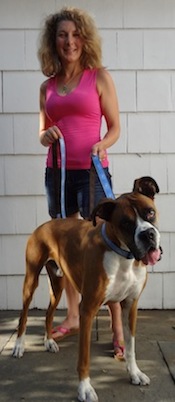
Fast forward to today and I have been lucky enough to crystalize all my talents and passions into my small business. Among other items, I design and sell dog collars and leashes with endurance sports motifs that are produced locally by a family-run factory. I donate 20% of corporate profits to an animal shelter. I use my marketing savvy to promote my products and business and work out of a home office with my rescue dog Bruno by my side. I am pretty convinced that without my corporate background and all the tools of the trade that I gleaned from it, I wouldn’t have had the proficiency to launch Trihound. Hindsight shows me that I wasn’t that lost at twenty-three. It wasn’t obvious to me at the time, but I was always on the right path, headed to exactly where I find myself now.

Born in England and based in Rye, New York, Melissa Grieco owns and operates Trihound LLC, a producer of lifestyle accessories designed for runners, triathletes, and the dogs who support them. In addition to the Trihound website, you can also follow the company on Facebook.  

Beginning Anew

In Essays on June 13, 2013 at 2:20 pm

By Dominique Veniez 

dommeditate2Not long ago, I came home from work on a bit of a high and deliriously updated my Facebook status. It read:

Yes—it took me until I was in my 40s to find a job that makes me happy. Boy, it was worth the wait! I think I’m right in my hunch that it’s unusual to start work at 7am and finish at 9pm and LOVE every moment : )

Honestly, seven years ago I would have rolled my eyes reading such “garbage” while sipping on a well-chilled Chardonnay. But then life has a way of running its own course. The more I fought my own path, the more reminders were rocketed my way, letting me know, in no uncertain terms, that I, indeed, was not the ruler of the universe and, in fact, have much less control of my destiny than I could imagine!

I grew up a child of privilege. By age 16, I had moved countries six times, could speak three languages fluently, and had been exposed to more cultural diversity than many experience in a lifetime. While I was worldly in some ways, I was clueless in others. I lived in a cocoon of fine homes, fancy cars, and private schools. During a bout of pneumonia, I remember asking the nurse at the hospital why there wasn’t any Dijon mustard to go with my meal.

I was always taught that I could be better…if I tried harder. That translated for me, from a very early age, into the notion that I wasn’t good enough, that at some point in the future, when I was my BEST, I would be good enough. I can imagine that some readers might relate. Don’t get me wrong. Hard work and dedication are, in my humble opinion, absolutely necessary for fulfillment in one’s life. It was, I believe, my child brain that didn’t process the instruction as it was intended.

And so, my childhood, teen years, and early adult life were infused with drive and a “do better” mantra. But for me, my drive to improve was only sustainable for brief periods of time. I would inevitably crash and burn into a variety of different abysses, only to pick myself up and try again and AGAIN. This time will be different.

After marrying in my late 20s, birthing two beautiful babies, and moving two more times, I hit bottom. It was as if I was floating outside of my body, watching my life, but not really participating in it. On the outside, I appeared to have the “perfect” life: wonderful husband, beautiful children, three dogs, lovely home, two cars. All that was missing was the picket fence. But my perma-grin and my maniacal volunteerism made up for the lack of a fence.

At home in the night, alone with my thoughts, I could not sit in my skin anymore. By day, I silently searched for ways to improve. I must be doing something wrong. There were self help books and healthy diets. There was constant busy-ness. And then, eventually, there was nothing. No more smile, no more energy, no real relationshipsjust me, living outside my body.

In the midst of all this, life handed me examples and opportunities to let go of my vice grip; she also pushed open the door, just a hair, that I might walk in a different direction. And on one fateful day, for some reason I decided to peer around that door. There I met someone: a fiery, red-headed dynamomy first yoga teacher. Imagine what your stereotypical yoga teacher might look like and then smash that image. As I spent my first few lessons curled up in the fetal position, I was present to just being “seen, heard, and understood” by the generosity of another human being. There was no judgment. And, for those moments, I was enough.

I have heard stories of sudden “Great Awakenings.” My story is nothing of the kind! As weekly lessons evolved into daily practice, yoga became my new “be better” project and, after countless hours, I was sure I had mastered the physical form. Now I was wholenow I was perfect! What had begun as healing had now become an unhealthy addiction. Yes, even yoga can be addictive when used as way out. Although I was certainly not living in that abyss anymore, I had not begun truly to live in my body and be in the acceptance of ME, flaws and all.

Following three years of “perfect” practice and after completing an intensive teacher training, I was struck with a violent attack of vertigo which, ultimately, lasted eight monthseight straight months of dizziness, nausea and, yes, definitely depression. My “drug” had been taken away. Yet again, I filled my life with busy-ness and bravado.

Finally, when the dis-ease of doing became too uncomfortable, I returned to my practice. There was fear of a repeat episode, no flexibility, no strength and, yes, a touch of humility. I was a beginner. Hallelujah! There’s something so beautiful about the excitement and fragility of new beginnings; the possibility to see with new eyes; to see the perfection of imperfection. Slowly, life itself began to take a little less effort.

That is where I am today. It’s as if it has taken 44 years to begin again; to be able to wake up some days with the excitement of a four year old. “What will happen today?”

And, so, now before I practice and before I teach any class, I remember. I remember that I am not the ruler of my students, let alone the universe. I remember that I am so incredibly fortunate to have been gifted a body that works in all its imperfection. Everyone has their own story that they bring to their mat and we are all completely whole just as we are. Each day we have the choice to begin again.

Dominique Veniez is a certified YogaWorks trained yoga teacher in Vancouver, BC with training in restorative yoga and yoga for PTSD, Addiction, and Mental Health. Through her own yoga journey, Dominique can attest to the healing qualities of yoga. Teaching in studio, school, hospital, and private settings, her belief is that the lessons learned on the yoga mat can show us how to stay steady in the chaos of life and keep a sense of humor along the way.

Photo credit: courtesy of Dominique Veniez.


Sign Me Up: From Grocery Carts to Model Ts

In Essays on May 15, 2013 at 8:14 am

Editorial note: I am struck by how much this veteran’s homecoming differed from this one’s.

By Jack Kissler

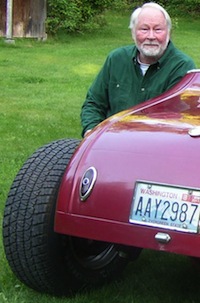
Jack KisslerMy first job was hustling shopping carts at the grocery store where my mother was a checker. They couldn’t pay me because I was only fifteen. The manager slipped my mom some overtime so she could pay me. I loved the job even if it was only for a week. I was outside, and I could run.

My next job was a gas station attendant. Flying A, just like The Fonz. I was outside, and I was around cars! That got me through high school.

At that point in my life, despite my 2.0 GPA, I figured I was too smart for college. But my mom said, “Jack, if you want to continue living here, you will go to school.” By the end of my first year at junior college, the edge was off my ego. I wasn’t as smart as I thought I was, and I felt pretty low.

They were hiring at the Post Office, so I took the test and got an offer about two months later. I loved the job. It was outside, and I could walk. I figured, here I am: set for life. Easy job, good pay, sick leave, three days off every fifth week…sign me up. That’s what I was doing on that fateful day in Dallas.

Soon, though, my days of carrying that leather bag were cut short–Uncle Sam needed my services. The draft was alive and well back then, so I could have waited for conscription, but I knew where I wanted to go. I made a deal with a recruiter: Europe in exchange for a three-year enlistment.

Within weeks, I was off to Fort Ord for basic training, then clear across the country to Fort Gordon for signal school.

The troop ship left from Brooklyn Army terminal, and I saw the Statue of Liberty over the stern as we went under the Verrazano-Narrows Bridge.  Five days in the North Atlantic was like a cruise ship. Not a ripple that August.

Bremerhaven, Paris, and then Fontainebleau. Home for the next 24 months. My job was to babysit a 2½-ton truck with a signal hut on the back. Oh yeah, it towed a trailer with two 5kw generators. I was part of a three-man team. Me, a PFC, an Sp4 and an E-5 Sergeant. Life was really boring. There was no work. We were just on standby. We field-trained twice a year. We played pinochle; we drank beer, smoked cigarettes and mostly wasted our days. Nights and weekends we traveled.

We would bug out of the lower motor pool to any place warm. I liked the Special Services library. I was hiding in the stacks one cold day and I found a college catalog that said I could go to school and study cars and become a high school auto shop teacher.

In an instant I knew that was me. Cal State LA, sign me up!

No more Army, no more Post Office, and only three years left until I could graduate. Thanks, mom.

Congress had just passed a good GI bill and they offered to pay all of my school costs. YES indeed! Sign me up! The VA also financed my first home in North Town. It cost $25,000.

During my third year of teaching, the movie American Graffiti hit the theaters. I loved that yellow ‘32 Ford. I wanted one. That was me. Sign me up!

But raising two boys and all that came with that, the five-window coupe was always just out of reach. Looking back, I probably could have swung it, but that’s water under the bridge. 

I taught high school shop for the next forty years and retired in 2008.

I now own a ‘27 Model T hotrod. My son owns a ‘29 SSK replica hotrod, which we converted into a woody wagon.

Next year, Im going to sell my ‘27 and start building a ‘32. It just might be yellow. 

All that has gone before has given me the skills, patience, partner, and cash I need to do what I’m doing now.

Jack Kissler, based in Gig Harbor, Washington, is probably hard at work on his Model T right now.

Settling for Passion

In Essays on May 5, 2013 at 3:56 pm

By Indrani Stephania Stangl

Indrani Stephania StanglMy ‘career path’ is a long road filled with wrong turns and poor decisions. Along the way, I discovered that you don’t need to be passionate about what you’re paid for; you just need to be passionate about something.

I grew up on the Stanford University campus. My best friends’ parents were Nobel Prize winners and international scholars. When I was a kid, I had the typical dreams: movie star, model, chef, veterinarian. But by college, I had no clue what I wanted to do with my life. When I chose a major, it was on the day of the deadline. I picked Cognitive Science without knowing what it was (and, frankly, I’m still a little unclear). When I graduated in 1991, I decided I wanted to be a lawyer (‘decided’ is a term used loosely here…it was more like ‘it sounds as good as anything else’). So I went to work at a corporate law firm as a paralegal assistant, alongside other goalless floaters who were struggling in various phases of life. It didn’t take long for the experience to quash whatever interest in law I’d had. The arrogant young lawyers struggled to bring in new business, and always felt the burden of being one billable minute away from losing their jobs. They took these stresses out on me, and I lasted less than a year.

The next year was one of jobless bliss. I moved back in with my parents on the Stanford campus, hung out with their dogs, sat by the pool, tanned, partied, and made friends at the junior college where I was taking prerequisites for vet school. I got a part time job at a veterinary clinic, only to discover that I was terribly allergic to cats. It did not matter how much Benedryl I took; I was a ball of snot and phlegm that could barely take a breath between sneezes. That was the end of that. The vet dream was flushed away with so many Kleenex.

One day while I was napping on the couch with the dogs after a few hours of sunbathing, my mother approached us with a rolled up newspaper. I thought she was going to discipline the dogs for being on the furniture. But instead, she beat me over the head with it screaming, “GET A JOB!” She threw the paper at me, revealing that it was the classifieds, with lots of red circles around things like “Nanny Wanted,” “Sous Chef,” and “Personal Assistant.” I was infuriated that my mother thought I should apply for any of these jobs; I was so much better than that. But I took her mental breakdown to heart. I needed a job. I needed a life. Hanging out with the dogs all day was fun, but I was whittling my time away. I looked at the paper and made a few calls, and sent a couple resumes to various places. I ended up temping for a burgeoning high tech company.

I was in the heart of Silicon Valley, but before the high tech boom. Friends who stayed with tech made millions at places like Yahoo and Google, but after a few months, I quit that temp job for a permanent job at a bank, making $2,000 a month. When the tech firm called to say they missed me and wanted to offer me a full time position, I turned them down saying I already had a job. They were purchased a year later by a huge company, while I was slaving away in a role in which I had zero interest. After three years, the bank offered me a promotion; my response was to quit. Around this time I rescued a dog from a shelter. She was neurotic as hell, skittish and aggressive. She brought a lot of focus to my life, even if my parents felt it was ‘misdirected.’ Looking back, my only real constant has been my need to have a dog around. A dog doesn’t judge what I’m doing with my life. A dog is a companion that cannot criticize.

I realize now that having too many choices, being told I could do whatever I wanted to do, that I was smart and talented and had the whole world at my feet, was debilitating in its own way. In retrospect, I probably should have gone into marketing or communications, but at the time I was overwhelmed with the possibilities, and I lacked guidance. Ironically, I went on to get a master’s degree in counseling, and I now work at Stanford, surrounded by bright kids with their futures ahead of them, declaring majors like Product Design, Journalism, Film Making, and Business. Oh, to go back in time—but fortunately, I’ve never felt that my job should be the source of my fulfillment.

Yes, I settled. But I have a good job, a job in fact that many would want. I work with smart students and brilliant faculty at one of the best colleges in the world. The environment is both physically beautiful and mentally stimulating. I make decent money—not enough to travel the world or buy nice cars or designer clothes, but enough to rent an apartment in a pricey neighborhood, go out to dinner a lot, travel a bit, and have a canine companion. I’ve decided it’s enough. My job doesn’t have to be my passion. Instead, I have a job that helps me support my passion.

I tell people I have a ‘real job’ and a ‘pseudo-job.’ I used to think that I would love to be paid for my ‘pseudo-job.’ People often say that it is incredibly lucky to be paid a salary for what one is passionate about. But if you are obligated to work at your passion, will the passion die with time? I am fortunate to have a job that affords me enough time and causes little stress so that I can focus on my non-profit dog rescue, my passion. If I were paid, I am quite sure I would not feel the same way.

For the last seven years I have been a volunteer at Pound Puppy Rescue, and for the last three of them I have been a member of the Board. I run all the logistics: manage the volunteers, answer all the e-mails, keep the 12,000 followers on Facebook updated several times per day, problem solve, put out fires, manage transportation from shelters to foster homes, coordinate the spay/neuter program, negotiate with shelters to release dogs, manage adoption events, care for sick puppies, and deal with the drama of rescue people. I see the horror and cruelty that our human race is capable of every day, as well as the love of people coming together to save a dog from imminent death.

Almost daily, I have inquiries about how to volunteer with the rescue, from people who say they are passionate about dogs. It is very rare for these people to volunteer more than once or twice, because they don’t have time—usually because of their ‘real’ jobs. As for my ‘real job’, I have had offers for promotions as well as new positions at other campuses and in private industry, but at this point in my life, I’m not interested. I’m in my mid-40s and I realize it would probably make sense for me to make a career change sooner rather than later, if something comes up. But for now, I don’t want to risk my ability to stay focused on my passion.

Yes, my volunteer ‘pseudo-job’ can be stressful—more stressful than my ‘real job.’ I lose sleep often. I am not paid a salary. However, I am rewarded tenfold by the feeling I get when I find a permanent home for a dog that feels love and safety for the first time. My ‘real job’ is just a job. My ‘pseudo-job’ is my life’s work.

Indrani Stephania Stangl was born and raised on the Stanford University campus, and currently works in Student Services there. She is a longtime volunteer at Pound Puppy Rescue, a non-profit rescue organization that saves pregnant dogs and puppies under three months from the pound. Even when she doesn’t have a dog by her side, she always has a pocket full of dog treats, just in case.

Photo credit: Jim Block 

The Gift of Getting Fired

In Essays on April 25, 2013 at 5:50 am

By Alison Buckholtz

AlisonI forgot their names immediately after they fired me, so I’ll just call them Dick and Jane. He was a shaggy cowboy; she was a wannabe New Yorker editor with big hair and cheap glasses. They were married to each other, and I, very single at age 22, was secretly comforted that the universe in all of its wisdom could find matches even for these strange specimens. But that’s where any positive feelings ended.

It was 1992. I had answered a vaguely-worded ad for an editor, placed in the local paper. I had just received my M.A. in English at the nearby university and wanted to stick around. I liked the house I shared with five other grad students, a ramshackle mansion close both to campus and to the main street that made up “town.” My roommates were toiling away at Ph.Ds in English literature, each unhappy in their own special way: one girl ate too much; one cried all the time; one refused to emerge from her room, even on Sunday mornings, without full make-up. The least miserable girl among us, who was brilliant, looked like Morticia Addams and never spoke. We rarely saw our male roommate, a farm-bred Fabio, who brought a steady stream of bespectacled beauties up to his room and locked the door.

It was one of the most optimistic times of my life because I knew that deciding not to pursue my Ph.D.to stop with an M.A. and earn money doing what I loved, which was working with wordswas the right path for me. I didn’t feel superior to my friends, but I did enjoy having somewhere to go at 8 in the morning, and being able to come home at 5 or 6 and do whatever I wanted. During grad school, I spent every evening in my library carrel, positioned near a narrow window where I could watch undergraduates with time on their hands playing Frisbee and having picnics. Not to be chained to that spot, looking on as others lived their lives, was my spiritual salary.

My real salary was another issue altogether. My parents had generously paid for school, but I was clearly on my own now, financially, which was fine by me. This editorial job paid just enough to get by, if I kept the babysitting gigs that had kept me afloat as I worked through the Victorian canon. The only real problem with the job was that I wasn’t really sure what the place did. It called itself something along the lines of Herbal Healing, Inc., and I was tasked with writing the monthly newsletter.

Dick and Jane, who owned the company, said they wanted a “real” writer to get their newsletter to a new audience, and they gave me my own office. I sat across from a large room full of young womenyounger than mewho had had babies in high school and needed to make a living. They sat in front of computer terminals all day, sifting through enormous piles of mail from people ordering some kind of cancer-killing pill or powder. I was still very unclear on all of that. All I knew was that my new colleagues typed names and check numbers into a database all day. They were friendly, but for some reason they all hated the single-serve pull-top cartons of Dannon yogurt I brought in, so eventually I just started eating lunch alone at my desk.

So here’s a typical day: Dick brought me hand-written letters from people who had been sick, then taken certain pills and healed themselves, and I wrote “human-interest stories” for the newsletter based on these testimonials. Jane stayed in her office. The girls across the hall entered data for 50 minutes at a time, then smoked outside for 10 minutes.

The only problem, as I saw it, was my mom. She’d warned me against taking the job from the moment she heard about it. We fought bitterly. She said the place practiced sham science, and that I’d be throwing my education away. But I suspected that what she really wanted was for me to be closer to home, and that my staying away was a terrible disappointment to her. There were harsh words and lots of tears, but I was determined to make my own way on my own salary in my own city. We stopped talking on the phone for a while. But then, on my first day at my new desk, a florist came to the office to deliver a dozen roses. They were from my mom. The card wished me good luck and lots of love.

When I accompanied the other girls on their smoke breaks, they told me things that made me nervous, like how most of the people who sent checks were very old and dying soon, so you had to be sure to get their money first before you shipped them the pills or powders. In the university library at night, I started reading up on the cancer cures I was writing about, and each one was quickly and easily disproven. I asked the law librarians where I could find information about how the company had registered itself. With each new, discouraging discovery, I felt a little sicker. I mentioned it to one of the girls during her smoke break the next day. She didn’t acknowledge anything, but I saw her talking to her supervisor later. I thought that was a good sign. These girls hadn’t had the time to do the kind of research I was doing, but they deserved to know if Dick and Jane were running a scam.

I resolved to plow ahead. I had to prove to my mom that I was right to take the position, even if, in the end, I exposed the place as a fraud. I’d be a different kind of superhero then, but still a superhero. Dick told me how well I was doing, so I knew I had more time to gather the evidence. The newsletter stories I was writing were reaching so many new people that Jane, on her one visit to my desk, told me that they’d be hiring a marketing director. He or she would share the office with me, and the interviews would start the next day. Would I mind if the interviewees asked me any questions?

I was flattered as the prospective candidates, who all looked like young Willy Lomans, filed through the office; I looked forward to having a colleague. Two days later, the smoke-break girl and her supervisor came to my desk and pulled up chairs. Only the supervisor spoke. Although I liked her because she was more of a mom type than the others, she was the most revolted by my yogurt of all of them; she only ate orange peanut-butter crackers from the vending machine.

“Dick and Jane want me to let you know that they’ve hired someone for the marketing job, and this person will also take over all of the writing,” she said. She had lost a lot of weight fairly recently, and the loose folds of her stomach rested on her lap like the softest pillow. No wonder she seemed so maternal.

“They have also asked me to tell you that we no longer need your services. I’m here to ask you to gather your belongings from your desk. I’ll stay in here while you do that. Smoke-break girl and I will escort you out.”

It dawned on me that they had interviewed my replacement right in front of me. The rest is a blur. I didn’t have much there so it didn’t take long: pencils and pens, a notebook, the card from my mom’s flowers, sending her love in another person’s cursive. I put it all in my purse as I was monitored. The supervisor hugged me, and I hugged her lap-pillow back, but it wasn’t very comforting.

I arrived back home around lunchtime. Although I’d only been working for about three weeks, an empty afternoon had already become foreign. Only Morticia was around, so we didn’t speak and I didn’t have to explain anything. I lay on my old mattress on the floor, a mattress that came with the house, and spent the rest of the afternoon sobbing. That night, I called my mom, who was immediately outraged on my behalf.  It was a lot of variations on “How dare THEY fire YOU,” and by the end of the conversation she vowed to call her lawyer friend so we could sue them for wrongful discharge. I was too sad to be part of that “we” in any meaningful way, but I went along with it because I was just relieved to be a “we” again.

I went along with it as I packed up my room, faxed resumes and cover letters, and planned to move to Boston to live with my best friend from college. I went along with it as I accepted an entry-level job at a prestigious publishing house in the Boston area. I went along with it as I saved my money, living with my best friend and her parents, whose kindness launched me back into a life of work.

One afternoon, my mom called me at my new office to tell me that the suit against my former employers, which I was sure was dead on arrival, had succeeded. There would be a certified check coming in the mail. It wasn’t as much as “we” asked for, but it was still significant. Mom thought I should use it to buy a really good mattress and bed frame.

So I did. Twenty-one years, six moves, and five fulfilling jobs later, one of my kids now sleeps on that same mattress. Clearly, mom was right.

Alison Buckholtz is the author of Standing By: The Making of an American Military Family in a Time of War (Tarcher/Penguin paperback, May 2013).  She wrote the “Deployment Diary” column on Slate.com from 2009-2010, and her other articles and essays have been published in The New York Times, New York Magazine, Real Simple, Parenting, Washingtonian Magazine, Salon.com and many other publications. She lives in the Washington, DC area.

Photo credit: Victoria Restrepo

If You Know

In Essays on March 8, 2013 at 5:31 am

Note: New essays are on hold for now, but here’s a gem from the archives. 

By Meg Heimovics Kumin

Meg_Heimovics_KuminWhen I was two, my father told me, “If you know what you want to do by age thirty-two, you are going to be all right.” I probably threw my Cheerios at him.

I was six when my father told me, “If you know what you want to do by age thirty-two, you are going to be all right.” I thought thirty-two was oldancient old. I had all the time in the world.

I was twelve when my father told me, “If you know what you want to do by age thirty-two, you are going to be all right.” By then, all the career and personality tests had told me I was exceptional at math and spatial reasoning, and I should be an engineer. I wasn’t sure I agreed.

I was seventeen when my father told me, “If you know what you want to do by age thirty-two, you are going to be all right.” By this time, I knew exactly what I wanted to do. Two years earlier I had picked up my dad’s 1970-something Nikon camera and fallen in love with the lens. I took classes and put a darkroom in my parents’ basement. I became photo editor of the newspaper and photographer for the yearbook. I spent all of high school behind the camera and under the dim, red light of the darkroom. What did I want to do when I grew up? I wanted to be a National Geographic photographer! I wanted to follow Jane Goodall around the primate world. I wanted to capture the next “Afghan Girl.” I wanted this, but I also knew it was a pipe dream, and never, ever, going to happenunless I got really good.

I was twenty-one when my father told me, “If you know what you want to do by age thirty-two, you are going to be all right.” This time I was on the cusp of graduating college with a degree in American Studies, with a focus on race, ethnicity, and culture. I stumbled into the degree following a thirst for understanding people and identities. It was a discipline that taught me to read, think, and writeand I loved it. But I was no Cornell West, and I worried that I’d spend the rest of my life waitressing.

So I spent my fourth and fifth years taking engineering electives including calculus, physics, and computer programming. It was coding that lit up my mind. It was like one, never-ending puzzle, and I loved it. I began to think maybe those career tests were right. Following graduation, I pursued a Master’s in Computer Science.

I was twenty-seven when my father told me, “If you know what you want to do by age thirty-two, you are going to be all right.” This time I smiled, and so did he. I had figured out what I wanted to be. I had just landed the best job in the world as a software developer at the University of Kansas Biodiversity Institute writing biological collections management software for natural history museums.

I got married and three months later, we found out we were pregnant, rather unexpectedly. Within a year of landing the best job ever, we welcomed our whoopsie-baby, and I had a crisis of identity. Did I want to be a grown up inhabiting the working world, or did I want to get lost in my child’s world? I decided I wanted it all.  Fortunately, my boss was more than accommodating. I became an anomaly in the Mommy Wars: I was a full-time employee who brought my baby to the office. With a bouncy seat next to my keyboard, I tickled his tiny toes while I wrote java code.

I was thirty-two when we welcomed our third-born to the world. We also welcomed the rotavirus, and influenza, and sick days quickly outpaced accrued leave. It became clear that being the mother I wanted to be AND having the career I thought was for me, was unsustainable. I quit my job as a software developer to stay at home and be a childware developer.

I was thirty-two when my father told me, “Your mother is in the hospital. The doctors say she has a tumor that runs from her ear, down her neck, along her spine, into her armpit and onto her lung. The prognosis is not good.”

I was thirty-two when my father had a nervous breakdownnot the metaphorical kind, but literal catatonia. The doctors said he needed an institution and a dose of shock therapy, or the prognosis would not be good.

I was thirty-two when neither parent could care for the other. For the next year and a half, it didn’t matter what I wanted to do, I did what I had to do. I got to wear my stay-at-home-mom hat and chemo-buddy hat and power-of-attorney hat. I might have looked all grown up, but I was navigating life like a six-year-old behind the wheel of a Mack truck. How I got through it without becoming an addict or clinically depressed is the topic of a story I will probably never write.

After my mom passed, I found writing and the words poured out of me. I read and wrote and wrote and read. I used the voice inside my fingers to try to make sense of where I’d been, who I’d become, and who I wanted to be.  I picked up my camera and began attending to small wonders; it filled me with a love of life again.

I was thirty-five when Kate Gace Walton butted into my life and did this thing that she does. She asked me, “What do you do? Will you write about it?” Little did she know it was a loaded question, as virulent and unsettling as this year’s flu.

It’s been two years since Kate first asked me to write this essay. I wish I could say I blew it off, but I didn’t. I obsessed about it. Countless times, I closed my eyes and asked myself, “What do you want to do?” Again and again, I thought about where I’d been and what I’d done. I thought about what I would regret having never done. The picture became clear. I wanted to live life in Kodachrome and capture it with the lens.

So I took the plunge. I built a website and made a plan. I announced to the world, “I’m doing it!” While thirty-two was my father’s number, perhaps thirty-seven is mine. I may not be a National Geographic photographer, but I’m on a path of passion and no regrets…and it feels better than all right.

Meg Heimovics Kumin is a photographer based in Lenexa, Kansas. Her work can be viewed at Meg Kumin Photography

Calling Dr. Hackenbush

In Essays on February 26, 2013 at 5:19 am

Editorial Note: Unlike most of the other essays published here, this piece was not written for Work Stew. Lisa Maguire created it for her blog, and the eagle-eyed Amy Gutman spotted it and sent it my way. Because it’s a fine example of stewing out loud, I asked Lisa for permission to add it to Work Stew’s essay collection, and she graciously agreed. 

By Lisa Maguire

Lisa_MacguireI recently started working as a volunteer at a horse rescue here in Connecticut. The barn has about a dozen unwanted draft horses salvaged from feedlot auctions. Many of them are workhorses from Amish country and know how to pull a cart or a plow. The rescue hopes to turn them into riding lesson horses, therapy horses, or, if they’re not sound enough for work, companion animals.

All afternoon I mucked out stalls, stacked hay bales, and filled water buckets in a freezing horse barn. I made numerous trips to a manure pile pushing a wheelbarrow wobbling over iced mud. I came home tired, sore, and smelly. I had a blast.

It occurred to me that this was the first meaningful work I had done in years. Work that had tangible results (I could see the clean stall) and a purpose (the rescue relies solely on volunteer labor). It was also work that I was able to do without any politics or controversy. Unlike working in an investment bank, no one disputed who was going to fill up which water bucket; no one stood next to your just-filled bucket and claimed your work as their own; no one emptied your just-filled bucket and then refilled the bucket, saying you had not done it right; no one debated the process controls and regulations around filling up the buckets, taking out measuring sticks to see how far from the lip of the bucket you’d filled.

My employer has just announced cost reductions that will eliminate 10,000 of us. This follows six white-knuckle rounds of lay-offs since 2008. People are losing their jobs left and right in my business. The majority of us let go will probably never work in finance again—the jobs aren’t there. Over half a million financial services jobs have disappeared in the last five years. Many people were hired back in 2009 and 2010, but they are now on the chopping block again as big banks move out of proprietary trading and shrink their balance sheets to comply with regulatory capital rules. When I see the magnitude of the expected job losses, I wonder what will happen to us.

Even in good times, many of us were never that into spreadsheets; we were lured by the money and the opportunity to work with smart people. Now that we are faced with being cut loose, and pondering a future outside the financial world, most of us are asking the same questions: What is meaningful work? Is doing what I love a viable option? Will I earn enough to pay back the investment in the training required? Will I ever be able to retire?

I love working with horses, so this week’s idea is to become a horse dentist. Laugh if you want, but there is no need for a veterinary degree (4 years and  about $200,000) and, unlike a farrier, a horse dentist doesn’t need the upper body strength of an Olympic shot putter.

It’s not surprising that I want to work with animals. My female friends and colleagues looking for their next career are all contemplating caring professions: teaching, social work, psychotherapy, physical therapy, yoga instruction, career coaching. This is probably in reaction to having spent most of our adult lives working in the macho culture of Wall StreetHorse dentistry is also a caring profession, and better than the above options for a misanthrope like me because I won’t have to listen to the incessant chatter of my clients.

Also interesting about the new careers most of my friends have considered is that few of them require as much education or as many qualifications as our current jobs. Partly this is due to our age and circumstances. We no longer have the luxury of medical school, or, in my case, vet school—we are middle aged and need to start earning soon. The other characteristic these jobs have in common is that they cannot be outsourced. Many of them are not even professions but trades.

I don’t know of any men thinking this way. Not a single man I work with has talked to me about another career outside of finance, much less downshifting to a more satisfying but lower paid job—like building bicycles or making furniture. Are they as Hanna Rosin suggests in her book The End of Men, unadaptable, unwilling to consider lower paid work, even if the Wall Street jobs disappear? Or is this just a recycling of the female ‘opt-out revolution’ while the men start their own businesses or get hired by hedge funds?

It has been said that the dot-com boom can be traced back to the recession of the early 90s, which shed so many corporate jobs. All that talent had to go somewhere, and it created an entirely new industry. I would expect something similar to happen now. This supposes, however, that the people leaving finance have the incentives to start something new and enterprising. Where will all that talent go? Hedge funds cannot possibly absorb all the people being sidelined. There will undoubtedly be new ideas and new industries coming from these laid-off brains.

At the same time I wonder: will all these forty and fifty year-old yoga instructors find clients? Will the newly certified teachers find schools? Are there enough insured bad knees out there to absorb all these physiotherapists? I don’t want to think about whether there will be enough horses out there with equine malocclusion

I would like to think that people will seek meaningful work they enjoy. I don’t think that the next new idea will make people as much money; the world is just too competitive (and any new industry or technology is unlikely to be able to create barriers to entry as effectively as old-line Wall Street firms). The rest of us too old to be a part of it may end up working in trades. Maybe this is the beginning of a societal shift; let’s call it The New Humility. We will have to wait to see the shape of this trend, how many of the people downshifting are older, or are women.  I will be awaiting this with interest from my desk at the bank, wondering whether the day will come when I will no longer be reviewing spreadsheets but peering deep into a horse’s mouth.

Lisa Maguire is a financial services executive and aspiring horse dentist based in Stamford, Connecticut.

How did I get HERE?

In Essays on February 14, 2013 at 6:52 am

By Lilly Dimling 

Lilly_DimlingI’m in a schoolyard in the Dominican Republic, surrounded by smiling kids. How did I get HERE?

It was not a straight route, I can tell you that. It had twists and turns that took me after college to live in Washington DC, Ann Arbor, Prague, San Francisco, Beaune (France), and Sydney. You’d think I’m running from the law, but no—I’m just in a constant state of reinvention or perhaps refinement.

Now in my mid-40s, I have three Master’s degrees, and I’m onto my third career. When I kept returning to school, some people asked why I didn’t just go ahead and get a PhD. These people didn’t know me very well—when there’s so much I’m interested in and so many places I want to see, why would I narrow my focus? Instead, over a period of two decades, I’ve followed my drive to learn and to travel. This took me from a job as the International Manager at the San Francisco Chamber of Commerce to a decade of working in the wine industry…and now it has brought me HERE, to this schoolyard.

I work for a nonprofit started in 2009 called the Global Soap Project. Did you know that 2.8 million bars of soap are thrown out per day in the U.S.? And did you know more than 2.4 million children die each year from hygiene-related illnesses? The single most effective and affordable way to prevent these deaths is hand washing with soap. So, the founder of our organization had an idea. Hotels donate to us their discarded soap headed to the landfill, and we reprocess it into beautiful new bars we deliver to orphans, disaster victims, the chronically poor, and our local homeless. Our vision is of a world in which no one dies because of a lack of access to soap. This is the simple version of what we do. The reality involves partnerships, distribution logistics, behavior modification, hygiene promotion, sustainability planning, monitoring and evaluation. It’s all easier said than done, but the world’s waste can and should be repurposed for good.

Officially my title is Operations Director, but as anyone who has worked in a small organization knows, I wear many hats. I manage the hotel partnerships, I run the volunteer program, I identify soap distribution partners and arrange shipments, I answer the phone and all general inquiries, I post on Facebook and tweet, etc. But the best part of my job is when I get to go in-country and observe our partners distributing soap. I get a tingling feeling and I exhale. Our soap, which has now made it to 28 countries, brings with it hope and dignity as well as health. Soap! Such a simple thing most of us take for granted. I’ve learned from this job to be thankful for what I have. I struggled with that for a long time, always wanting more, anticipating something better up ahead. I now realize that I already have far more than I need.

So, this is where I am–working in water, sanitation and hygiene. HERE can mean Atlanta, Georgia, where our headquarters are—or it can mean any one of the sites we visit. Whatever it means, I know this: I feel intimately involved in international development and global health. And I like it HERE.

Lilly Dimling works as the Operations Director for the Global Soap Project, based in Atlanta, Georgia.

How Counting Crows Saved Me from Corporate Law

In Essays on January 16, 2013 at 10:04 pm

By Kevin McHargue

Kevin_McHargueIn some ways, succeeding at the wrong thing is worse than failure. Failure is self-correcting in the sense that it will usually motivate you to stop, reassess your situation, and make necessary course corrections. The appearance of success can deaden all those instincts, until something brings your latent doubts to the surface. I started my career as a lawyer on what looked like the right track, but some part of me knew that it was not right. And it took a seemingly random line from a pop song to get me to understand my mistake.

In 1996, shortly after graduating law school, I was exactly where I was supposed to be: working as an associate in the Austin office of a prestigious corporate law firm. I was working on high-profile cases for prominent clients, including an up-and-coming little company called Enron. Looking back, I was a million miles from what I had envisioned when I started law school. I had always planned to pursue a career in public interest law, whether with a government agency or a private firm. I put myself through law school working for a member of the Texas Senate and for the state health commission, and I fully intended to seek that sort of work after graduation.

Then pressures both subtle and overt began to reshape the plan. Apart from the question of money—which was certainly a significant one—I began to feel that it would be something of a disappointment not to land a job with a big firm. That was the path all of my friends were following, and my original plan began to look like selling myself short.

I never made an explicit decision to change my objectives. Instead, in a largely unconscious way, I began to convince myself that working for a big corporate firm was public interest law, of a sort. And it was not an entirely ridiculous claim. The firm was doing interest work in energy deregulation (I did not know at the time what fiascos lay ahead in this arena), and if you squinted a bit that looked like a worthwhile public policy goal.

But I was profoundly unhappy, although I would never have used such melodramatic words at the time. I had a cloud of dissatisfaction around me, but my doubts had not crystallized into any concrete desire to change direction.

On my drives to work, I would listen over and over again to the Counting Crows album August and Everything After. It’s a first-rate album, but the song that really got to me was a melancholy ballad called “Raining in Baltimore.” It’s a sort of hymn to regret and unmet needs. And one line in particular seemed aimed directly at me:

You get what you pay for, but I just had no
intention of living this way.

I could probably have learned the same lesson from Thoreau, who wrote that he moved to Walden “to live deliberately”—but Thoreau never put out an album. It was not that my choices weren’t perfectly sensible; it’s that they weren’t my choices. I had allowed myself to revert to a sort of default setting, seeking out a safe, pre-approved path to success. But I had never had any intention of living that way.

I had talked myself into a life of working extremely hard to achieve goals that meant nothing to me. I deserved better. For that matter, the clients—including  Enron—deserved better. Corporations should be represented by people who want to do the job well, not by disaffected liberal arts majors.

Having had this quiet epiphany with the Counting Crows, I went in for my first performance review. The supervising partner thought my legal skills were fine but noticed I did not seem to be connecting with the clients on a personal level. He suggested I take up golf and get to know the executives socially.

Objectively speaking, this was good professional advice. But the idea of learning to play a game I found tedious, in order to get closer to people I found more tedious still, reinforced my sense that I had stumbled into someone else’s life. It was time to move on, however scary and uncomfortable that might be. I started talking to former colleagues about my need for a change.

By a stroke of luck, one of the people who heard about my situation was my former boss, who had recently been elected to Congress. He asked me to join his staff in Washington D.C.—at about half the salary, in a city that was twice as expensive. Such is the price of making your own choices.

But my luck continued: that choice ultimately led to a career path that was both fulfilling and financially rewarding. But even if my new direction had turned out to be less lucrative, I think I would have still been happier. Following my own intentions rather than other people’s expectations is just more fun.

Kevin McHargue is a lawyer and stay-at-home dad living in Portland, Oregon. For more thoughts on work and other subjects, check out his blog at kevinpdx.com and his daily video journal.

Raspberry

In Essays on December 11, 2012 at 7:36 pm

Editorial Note: Unlike most of the other content on this site, this piece was not originally written for Work Stew. Writer T.J. Mitchell posted it on his blog earlier this year and, when I asked if I could re-publish it for Work Stew’s readers, he graciously agreed. To me, it’s an illuminating glimpse into Mitchell’s work, his wife’s work, and their many collaborations, both writerly and domestic.  

By T.J. Mitchell

TJ Mitchell_and_Judy MelinekJudy and I collaborate by e-mail. The raw material for the book “Working Stiff” is her ten year-old journal, chock full of medical and law enforcement shorthand and jargon. We can never work on the writing face-to-face, because whenever we are together with each other we are also with our three children. They are not especially demanding children, but that’s like saying salmon is not an especially fishy fish. Leave it out on the counter long enough, and you’ll smell it. Leave our kids together in the house long enough, and you’ll hear some demands.

So my working day consists of the child-free hours between my dropping the last one off at school, and picking the first one up. During those same hours Judy is at work herself, so I email my questions to her, and she answers them from her laptop during lunch break. I crafted one such email while I was putting together the chapters on what an autopsy consists of, and how exactly she performs one. My questions about the science tend to be interrupted by more mundane musings. Here is the email I sent my wife, verbatim:

1) What’s the most money you’ve ever pulled off a corpse? How about jewelry, electronics? Is it your responsibility to take charge of loaded guns that might be on the body but were not used?

2) Review for me briefly what you do when you find a huge wad of cash on a body.

3) Don’t mention the fleas to your mother any more. She’s driving me crazy. She refuses to believe her dog could have fleas, so she contends that Dina’s picking them up in the sand at the playground. I don’t know much about fleas, but I do know they like warm, furry animals. I doubt very much they hang around in cold, damp sand waiting for furless little girls to come along. Even if they did, they wouldn’t last long on Dina’s skin. Your mom’s now insisting we get an exterminator to examine the kids’ rooms while we’re away next month. Would you please keep an eye on the flea bites, examine Dina nightly, and don’t talk to your mom about it. There’s nothing we can do about it anyway—the dog is on flea medication and its owner is in denial. We don’t even know if these bites are from fleas. This note has nothing to do with the book, but your mom just interrupted me in order to raise the subject, again, so I want you to know. Back to business.

4) I just now had a flashback to my days as a secretary at Carolco Pictures, trying in vain to spell RESERVOIR DOGS correctly. Day after day I’d type it RESEVOIR DOGS. It would seem that thanks to my native Boston accent, that interior ‘r’ is not only silent but also invisible. Now I’m working off your journal, and couldn’t for the life of me figure out why the computer kept telling me I was mis-spelling “paraphenalia.” I swear it has never occurred to me that this word is spelled—or pronounced—”paraphernalia,” with two r’s. OK, now back to business, I promise.

5) I think I got the description of removing the kidneys the way I like it. You can check it tonight. Do you remove the adrenal glands from the kidney or leave them on? Please describe the physical appearance of the adrenals.

6) You wrote that you reach way down into the retroperitoneal cavity and pull out the bladder, uterus and rectum all at once. Don’t you have to sever the rectum from the anus first? How do you do that?

7) I conclude the section on organ removal with the following; is it accurate?

We’re now finished eviscerating the patient. Everything I’ve described, from Y-cut to testicular replacement, only takes about half an hour and is the easiest part of an autopsy.

8) Did you know that “raspberry” has a silent ‘p’ in the middle? I didn’t, not until the spell-check caught it. Fascinating.

9) Make sure you buy two or even three of those cleaned Dungeness crabs again tonight when you go to the Cal-Mart, and have them put ’em on ice. We’ll have them for dinner after you get home with Leah. Don’t forget to buy milk, too. Do you find me highly distractible? Did you know “distractible” is not technically a word according to this e-mail program’s spell check? Maybe I misspelled it and it’s supposed to be “distracterble” or “distractspible.” Again, fascinating.

10) When you take a nerve tissue sample from the stock jar, which nerve do you cut? Does the tech put the sample in formalin immediately, or does it just sit there in the jar until you’re done with the autopsy?

11) You have in your notes:

Breastplate goes back in abdomen, or back in place in chest.

What does this mean, “back in abdomen?” Do you try to cram it into its proper place, and if it doesn’t fit you just plop it on top of the bag of organs and sew the whole mess up? That’s all for now.

Love,
TJ

T.J. Mitchell is a San Francisco-based writer and stay-at-home dad. He has worked as a screenwriter’s assistant and script editor since 1991. Working Stiff, which he is co-writing with his wife Dr. Judy Melinek, a forensic pathologist, is his first book. For book updates, check out Working Stiff’s Facebook page.